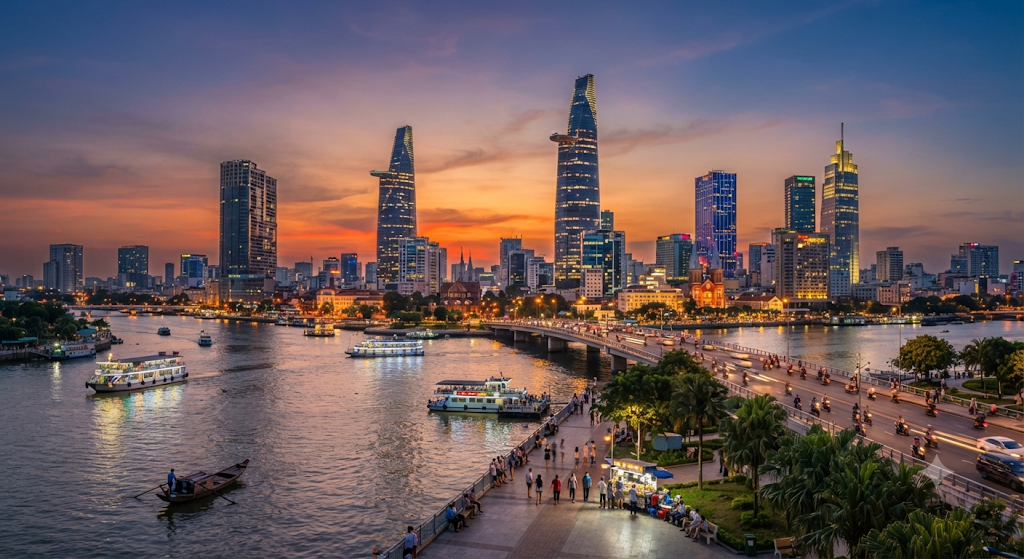

The Picture of Southeast Asian GDP Growth Over the Past Three Decades (1994–2025)
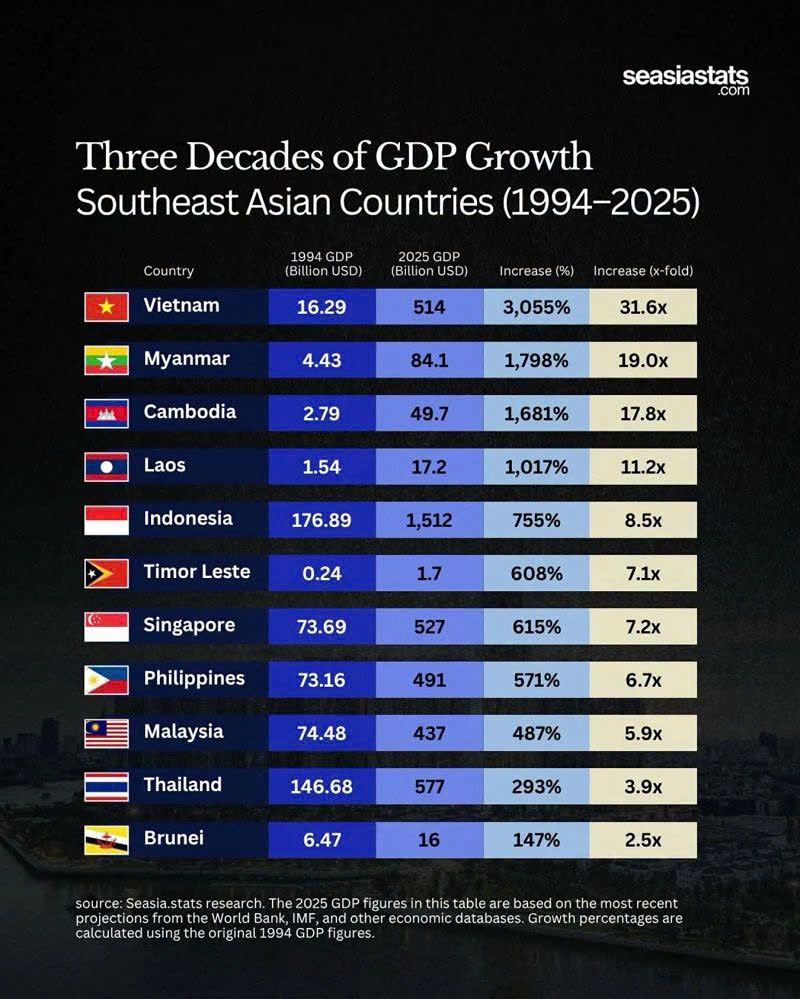
Over the past three decades, Southeast Asia has witnessed strong and spectacular economic transformations. Based on research data from Seasia.stats and the latest projections from the International Monetary Fund (IMF), the World Bank, and other economic databases, the comparative chart of Southeast Asian GDP scale from 1994 to 2025 shows proud development milestones for each country in the bloc.
Vietnam Leads the Region in GDP Growth Pace
Vietnam's Outstanding Economic Growth
The brightest spot in the statistical table is Vietnam's rapid growth rate. Specifically, in 1994, Vietnam's GDP scale reached only about 16.29 billion USD. By 2025, this figure is projected to rise to 514 billion USD.
Corresponding to a massive growth rate of up to 3,055%, the country's economic scale has expanded 31.6 times over three decades, ranking first in the entire Southeast Asian region in percentage increase margin and multiplier. This achievement proves the success of the renovation process (Doi Moi), foreign investment attraction, and deep international integration strategy.
Other Notable Leapfrogging Countries
Besides Vietnam, several other countries in the region also recorded impressive growth calculated by the multiplier (x-fold):
- Myanmar: Recorded GDP growth from 4.43 billion USD (1994) to 84.1 billion USD (2025), equivalent to a 1,798% increase (19.0 times).
- Cambodia: Achieved a growth rate of 1,681% with GDP scale increasing from 2.79 billion USD to 49.7 billion USD, corresponding to 17.8 times.
- Laos: Witnessed economic scale increase from 1.54 billion USD to 17.2 billion USD, equivalent to a 1,017% increase or 11.2 times.
Economic Scale of Traditional Foundations and Other Countries in the Bloc
Group of Countries with the Largest Economic Scale
Although traditional leading countries had a much larger starting point in 1994, their percentage growth rates progressed more stably because their economic scales had already reached a certain size:
- Indonesia: The region's largest economy recorded a 1994 GDP of 176.89 billion USD and is projected to reach 1,512 billion USD in 2025, increasing by 755% (8.5 times).
- Thailand: Achieved a GDP scale from 146.68 billion USD (1994) to 577 billion USD (2025), increasing by 293% (3.9 times).
- Singapore: Increased from 73.69 billion USD to 527 billion USD, corresponding to a 615% increase (7.2 times).
- Malaysia: Reached 437 billion USD in 2025 from 74.48 billion USD in 1994, increasing by 487% (5.9 times).
- Philippines: Increased from 73.16 billion USD to 491 billion USD, equivalent to a 571% increase (6.7 times).
Small-Scale and Special Economies
- Brunei: GDP increased from 6.47 billion USD to 16 billion USD, increasing by 147% (2.5 times).
- Timor Leste: Recorded from 0.24 billion USD in 1994 to 1.7 billion USD in 2025, equivalent to a 608% increase (7.1 times).
Vision and Future Prospects of the Southeast Asian Economy
Overall, the three-decade data (1994–2025) outlines a dynamic panoramic picture of the Southeast Asian economy. The global manufacturing center shift, strong institutional reforms, and the breakthrough of countries like Vietnam, Myanmar, and Cambodia have contributed to making the region one of the important growth engines of the world economy.
In the future, maintaining innovation, developing digital infrastructure, and green transition will be key for Southeast Asian countries to continue consolidating their solid position on the global economic map.