
Transforming Vietnam's Economy from Assembly to High Value
In the journey of global integration and development, the Vietnam economy is facing a historic strategic turning point. Based on major policy reports and guidance documents such as Vietnam Playbook #20: The Missing Middle, the S-shaped country is not only stopping at the role of a leading regional manufacturing and assembly hub, but is gradually stepping up into a value-creating economy. The overarching message "From Made in Vietnam to Created in Vietnam" clearly reflects the aspiration to shift from pure assembly to self-reliant design, brand building, and reaching out to the global market.
Solid Foundation of the Private Economic Sector
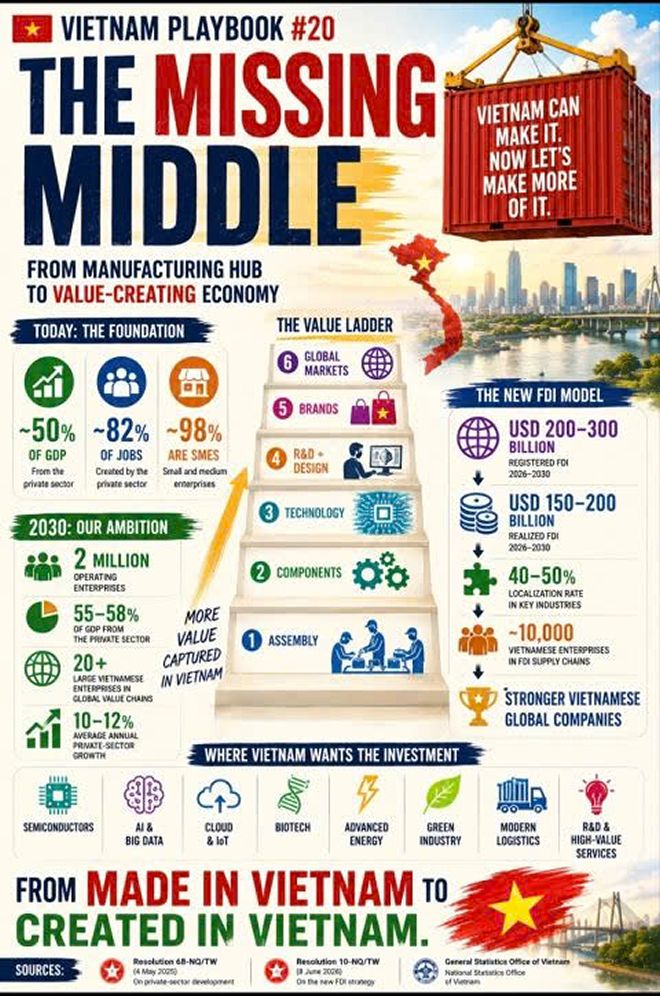
The transformation of the Vietnam economy is built on a very solid practical foundation from the private sector and domestic business community. Currently, the private sector contributes about 50% to the gross domestic product (GDP), while generating about 82% of total jobs for workers. Notably, up to 98% of operating enterprises belong to the small and medium-sized enterprise (SME) group, acting as the core foundation promoting entrepreneurial spirit and market dynamism.
The Value Ladder and Strategy Toward 2030
To enhance its position in the global supply chain, the economic development strategy outlines the "Value Ladder" model consisting of 6 clear steps:
- From the lowest step of assembly
- Moving up to components production and technology integration
- Rising to higher steps including research & design (R&D), brand development, and finally conquering global markets
Looking toward 2030, the Vietnam economy sets ambitious targets with the goal of reaching 2 million operating enterprises, raising the private sector's GDP contribution share to 55 - 58%, having more than 20 large-scale enterprises deeply participate in global value chains, and maintaining an average annual private sector growth rate of 10 - 12%.
New Generation FDI Attraction Model and Priority Sectors
Alongside domestic internal strength, the new-generation foreign direct investment (FDI) attraction strategy also plays a vital leverage role for the Vietnam economy in the 2026 - 2030 period. Registered FDI capital is projected to reach $200 to $300 billion, with realized capital reaching $150 to $200 billion, while raising the localization rate in key industries to 40 - 50%.
In particular, investment capital in the coming period will strongly focus on high-tech and sustainable sectors, including:
- Semiconductors and Artificial Intelligence combined with Big Data (AI & Big Data)
- Cloud Computing & IoT, and Biotechnology
- Advanced Energy and Green Industry
- Modern Logistics, along with R&D and High-value Services
With the synchronous combination of macroeconomic policies, the self-reliance spirit of domestic enterprises, and selective FDI attraction orientation, the Vietnam economy is steadily stepping toward a prosperous future, strongly affirming the value of the Vietnamese brand on the global economic map.